
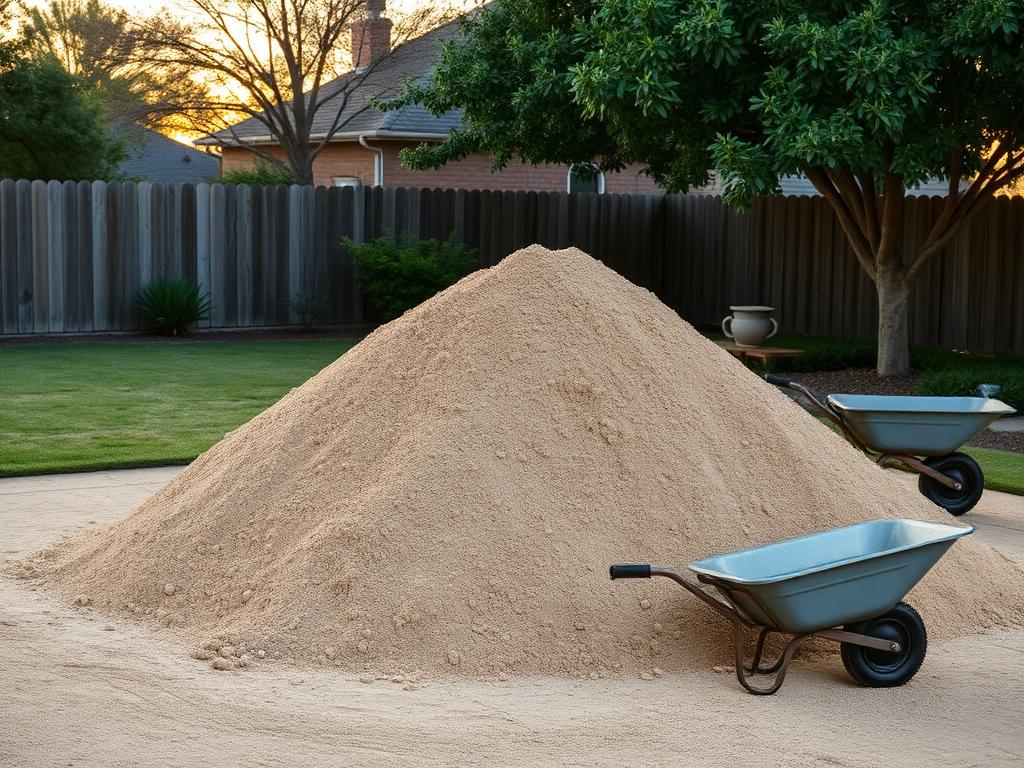
How Much Mason Sand Do You Need? Tonnage & Cost Calculator
Calculating the right amount of fine mortar sand for your project is crucial for efficiency and cost-effectiveness. Use our guide to determine the exact tonnage you'll need, factoring in coverage and common mortar mix ratios for brick, block, and stucco applications. This helps avoid ordering too little or too much, ensuring your DFW-area construction or landscaping project stays on track and on budget.
Understanding Mason Sand: The Foundation of Strong Mortar
Mason sand, often called fine mortar sand or masonry sand, is a critical component in various construction projects. Its fine, uniform particles are ideal for creating smooth, workable mortar mixes used in bricklaying, block installation, and stucco applications. Unlike coarser sands used for concrete or fill, the consistent texture of mason sand ensures strong bonds and a clean finish. For more in-depth information on its properties and uses, you can visit our detailed guide: What is Mason Sand? Uses, Specs, and When to Order It.
Choosing the correct type and quantity of sand impacts the strength, durability, and appearance of your finished work. Getting the calculations right from the start can save time, reduce waste, and keep your project on schedule.
How Much Fine Mortar Sand Do You Need? Calculate Your Tonnage
Determining the precise amount of fine mortar sand required involves a few key steps: calculating the volume needed, converting that volume to tonnage, and then factoring in common mortar mix ratios.
Step 1: Calculate the Volume of Your Project
First, you need to calculate the total volume of mortar your project will require. This depends on the type of masonry unit (brick, block) and the joint thickness.
For Brick: Standard bricks are typically 8" x 3-5/8" x 2-1/4" with 3/8" to 1/2" mortar joints.
- Rule of Thumb: Approximately 1/4 cubic foot of mortar per standard brick.
- More Detailed:
- Calculate the surface area of one brick plus one mortar joint (length x width + length x joint thickness + width x joint thickness).
- Estimate the total surface area of your wall.
- Divide the total wall surface area by the surface area per brick/joint to get the number of bricks.
- Multiply the number of bricks by the mortar needed per brick.
For Concrete Block: Standard concrete blocks (CMUs) are usually 16" x 8" x 8" with 3/8" or 1/2" mortar joints.
- Rule of Thumb: Approximately 0.75 to 1 cubic foot of mortar per 100 standard blocks.
- More Detailed:
- Calculate the volume of the horizontal and vertical mortar joints per block.
- Multiply by the total number of blocks.
For Stucco/Render: Stucco application varies widely based on the number of coats (scratch, brown, finish) and thickness.
- Rule of Thumb: A 1/2-inch thick stucco layer will cover approximately 80 square feet per cubic yard of mix.
- More Detailed:
- Calculate the total square footage of the area to be stuccoed.
- Multiply by the desired thickness (in feet) to get the total cubic footage.
- Convert cubic feet to cubic yards (divide by 27).
General Volume Calculation (for any area): Measure the length, width, and depth (or thickness) of the area you need to fill with mortar.
- Volume (cubic feet) = Length (feet) x Width (feet) x Depth (feet)
- Volume (cubic yards) = Volume (cubic feet) / 27
Step 2: Convert Volume to Tonnage
Once you have your total volume in cubic yards, you can convert it to tonnage. The density of dry mason sand typically ranges from 2,600 to 3,000 pounds per cubic yard, or roughly 1.3 to 1.5 tons per cubic yard. It's always safer to use the higher end of the estimate, especially if the sand might be damp.
- Estimated Tonnage = Volume (cubic yards) x 1.4 tons/cubic yard (average)
Step 3: Factor in Mortar Mix Ratios
Now, you need to account for the actual proportion of fine mortar sand in your chosen mortar mix. Mortar is typically a blend of sand, cement, and often lime, plus water. The specific ratio depends on the required strength and workability, which is often dictated by project type and building codes.
Here's a common guide for various mortar types:
| Mortar Type | Sand (parts) | Portland Cement (parts) | Hydrated Lime (parts) | Applications |
|---|---|---|---|---|
| Type M | 3 | 1 | 1/4 | High-strength, severe weather, heavy loads, below-grade masonry, foundations, retaining walls. |
| Type S | 3 | 1 | 1/2 | Medium-high strength, general use, exterior walls, resisting lateral loads (wind, seismic), veneers. |
| Type N | 3 | 1 | 1 | Medium strength, general use for above-grade, exterior and interior walls, chimneys, parapets, softer masonry units. |
| Type O | 3 | 1 | 2 | Low strength, non-load-bearing interior walls, historic preservation, repointing, flexible, less shrinkage. |
| Stucco | 3-4 | 1 | 0-1 (optional) | Exterior wall finish, varying by coat (scratch, brown, finish). |
Example Calculation: Let's say you calculated a total need for 10 cubic yards of mortar mix. If you are using a Type N mortar (3 parts sand, 1 part cement, 1 part lime), the sand would constitute 3/5ths (60%) of the total dry volume.
- Sand Volume Needed (cubic yards) = Total Mortar Mix Volume (cubic yards) x (Sand Parts / Total Parts)
- For Type N: 10 cubic yards of mix * (3 / 5) = 6 cubic yards of sand.
- Total Tonnage of Fine Mortar Sand = 6 cubic yards * 1.4 tons/cubic yard = 8.4 tons.
Always round up your tonnage to ensure you have enough. It's better to have a little extra than to run short in the middle of a job.
Fine Mortar Sand Delivery to DFW and Beyond
Kaufman Sand & Gravel makes getting your fine mortar sand, or any other bulk material, straightforward and reliable. We understand the tight schedules of contractors and homeowners alike in the DFW metroplex.
Our delivery service includes:
- Flat Rate Delivery: $150 per load for up to 7 tons within 20 miles of Scurry, TX (75158).
- Beyond 20 Miles: Metered per mile for deliveries outside our standard zone.
- Multiple Load Discounts: Available for larger projects requiring several deliveries.
- Large Orders: For loads over 28 tons, we utilize dump truck delivery. Please call us for a custom quote.
We deliver six days a week to keep your projects moving. Sundays are available by request for urgent needs. Need different materials? We also provide gravel delivery and topsoil delivery across our service area.
Our service area extends throughout Kaufman County and into the broader DFW region, ensuring contractors and homeowners have access to quality materials when they need them.
Need to Clear Out Before You Build? Garage Clean-Out & Dumpster Rentals
In addition to bulk material delivery, Kaufman Sand & Gravel also offers convenient solutions for site preparation and clean-up. Our garage clean-out and dumpster rental services are perfect for clearing away debris before a new construction project or after a renovation.
- Trailer Rental: $350 for a 3-day trailer rental. We drop the trailer, you load it at your convenience, and we haul it off.
- Live Load Service: $250 for a live load (up to 45 minutes). We bring the trailer, you load it, and we haul it away immediately.
This service, found under garage clean-out, is an excellent way to manage waste efficiently, allowing you to focus on the build without worrying about debris removal.
Fine Mortar Sand for Your Next Project
Whether you're tackling a new build, a renovation, or a repair, having the right quantity of fine mortar sand is essential. From strengthening brick walls to creating smooth stucco finishes, quality sand ensures the longevity and appearance of your work. By accurately calculating your needs, you can streamline your material procurement and avoid unnecessary delays or expenses.
Kaufman Sand & Gravel is your trusted partner for high-quality bulk material delivery in Scurry, Kaufman County, and the greater DFW area. We are committed to providing reliable service and top-grade materials for all your construction and landscaping endeavors.
Frequently Asked Questions About Fine Mortar Sand
Q1: What's the difference between mason sand and concrete sand?
A1: Mason sand (fine mortar sand) is finer and more uniform, making it ideal for smooth, workable mortar and stucco. Concrete sand is coarser with larger, varied particles, providing better aggregate for strength in concrete mixes.
Q2: Can I pick up fine mortar sand directly from you?
A2: Kaufman Sand & Gravel primarily focuses on bulk material delivery to your job site. This saves you time and effort, especially for larger quantities of fine mortar sand. For specific inquiries about pickups or to discuss your material needs, please call us.
Q3: What if I need a material other than fine mortar sand?
A3: We offer a variety of bulk materials, including gravel for driveways or drainage, and topsoil for landscaping projects. Check out our gravel delivery and topsoil delivery pages for more information, or contact us directly to discuss your specific requirements.
Don't let material estimates slow down your project. Get the exact amount of fine mortar sand you need, delivered directly to your site.
Request a delivery quote today! Call us at (951) 239-9096 or email kaufmantrailerrentals@gmail.com to get a precise quote for your bulk material delivery and ensure your DFW-area project stays on schedule. We're ready to help you succeed!